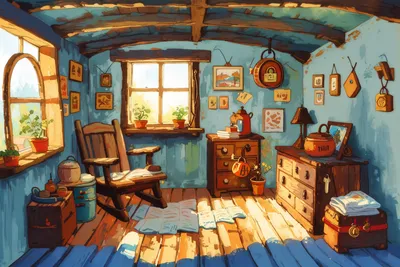
The Melody in the Woods
At the edge of the great dark forest lived Vera, in a small wooden house at the end of the village. Every evening, shortly after sunset, she heard a thin, melancholy melody coming from among the trees — a few repeated notes, sweet but sad, like a question with no answer.
“Can you hear it too?” she asked her mother one evening, ear tilted toward the window.
“I only hear the wind in the leaves, sweetheart,” her mother replied, smiling. “It must be your imagination.”
But Vera knew she hadn’t imagined it. Night after night the melody returned, always at the same hour, always from the same direction: the heart of the forest, where no one from the village ever ventured after sundown.
One evening, unable to resist any longer, Vera grabbed a lantern, wrapped herself in her warmest shawl, and slipped out, following the thread of that mysterious music into the ever-thickening trees.
The forest at night was different from how she remembered it by day: the shadows seemed longer, the sounds closer, and more than once her heart leapt into her throat at the sudden rustle of some nocturnal animal. But every time she thought about turning back, the melody rose again, a little closer, a little clearer, and Vera kept going.
She crossed a stream hopping from stone to stone, pushed her way through brambles and jutting roots, until she reached a clearing lit by the moon, at the center of which stood an old hollow oak. That’s where she saw him, perched on a low branch: a small owl blowing gently into a tiny bamboo pipe, making exactly the melody that had guided her there.
“Oh!” Vera exclaimed, surprised. “Is it you who plays every night?”
The owl jumped, nearly dropping his little pipe.
“No human has ever found me before,” he said, in a shy little voice. “My name is Bubo. I play every night hoping someone from my family will hear me and come looking.”
Bubo told Vera that, during a fierce storm a few weeks earlier, he had gotten separated from his flock while they were migrating through the forest, and had been left alone, too scared to fly far from that oak in search of the way home.
“Why didn’t you just cry out to call them?” Vera asked.
“A cry is lost in the wind in an instant,” Bubo answered. “But a melody, if someone listens closely, can be recognized even from far away. It’s the only thing I know how to do to be found.”
Vera looked at the little owl, so determined and yet so alone, and decided she couldn’t leave him there another night.
“I’ll help you look for them,” she said. “But I don’t know the way beyond this clearing.”
“I can’t fly far on my own,” Bubo admitted, “but if you carry me on your shoulder, I can keep playing. Maybe that will be enough for them to hear us.”
Together they went deeper into the forest, Vera walking carefully, Bubo playing his little melody with every step. The path soon grew steeper and rockier, until they found themselves facing a deep ravine, crossed only by an old fallen log, narrow and unsteady.
“I’ll never manage to cross that in the dark,” Vera whispered, her voice trembling.
“Follow the rhythm,” Bubo said. “One step for every note. Don’t look down, just listen.”
Bubo began playing a slow, steady melody, and Vera, taking a deep breath, started crossing the log one step at a time, following the beat of the notes instead of looking at the darkness below her. Note after note, step after step, she reached the other side safely.
It was right at that moment, as she caught her breath, that they heard something: another melody, distant but unmistakably similar, answering Bubo’s from across the valley.
“It’s them!” Bubo cried, flapping his wings with excitement. “They heard me!”
The two followed that call, closer and closer, until they saw, perched on a great branch, a flock of owls waiting, lit by the moon. Bubo flew off Vera’s shoulder to finally reach his family, amid joyful hoots and wings weaving together in an embrace.
“Thank you, Vera,” Bubo said, coming back one last time to say goodbye. “Without your courage to follow the music, I would never have found them.”
“Without your music, I would never have found the courage to come this far,” she replied, smiling.
Vera came home that night with her clothes torn by brambles and her heart full of wonder. From then on, whenever she heard an unfamiliar melody on the wind, she always stopped to listen closely — because she had learned that even the smallest sound, if someone takes the trouble to follow it, can carry you very far.